
Perimenopause Is Puberty’s Older Sister: A Simple Guide to Hormonal Shifts
Perimenopause can feel like puberty’s older sister: emotional, physical, confusing, and sometimes dramatic. The difference is that most of us were warned puberty was coming. Perimenopause often arrives while women are managing careers, families, relationships, aging parents, sleep loss, stress, and a body that suddenly feels less predictable.
“Perimenopause is not a quiet, gentle slide for every woman,” says Kristina Calligan, FNP. “Estrogen and progesterone can surge, drop, and shift so dramatically that a woman may feel like she is living in a different body from one week to the next. Naming those shifts is empowering because it helps women stop blaming themselves and start understanding what is happening.”
Perimenopause is the transition leading up to menopause. Menopause itself is one point in time, confirmed after 12 months without a period or spotting. Perimenopause is the stretch before that when ovarian hormone patterns become less consistent. It can last several years and may begin in the 40s, although some women notice changes earlier or later.
Why the puberty comparison makes sense
Puberty and perimenopause are both hormonal transition phases. During puberty, the brain and ovaries are learning how to create a regular cycle. During perimenopause, that same system begins changing again as ovarian function becomes less predictable. Both phases can affect mood, skin, sleep, bleeding, body composition, libido, and a woman’s sense of herself.
What is happening hormonally?
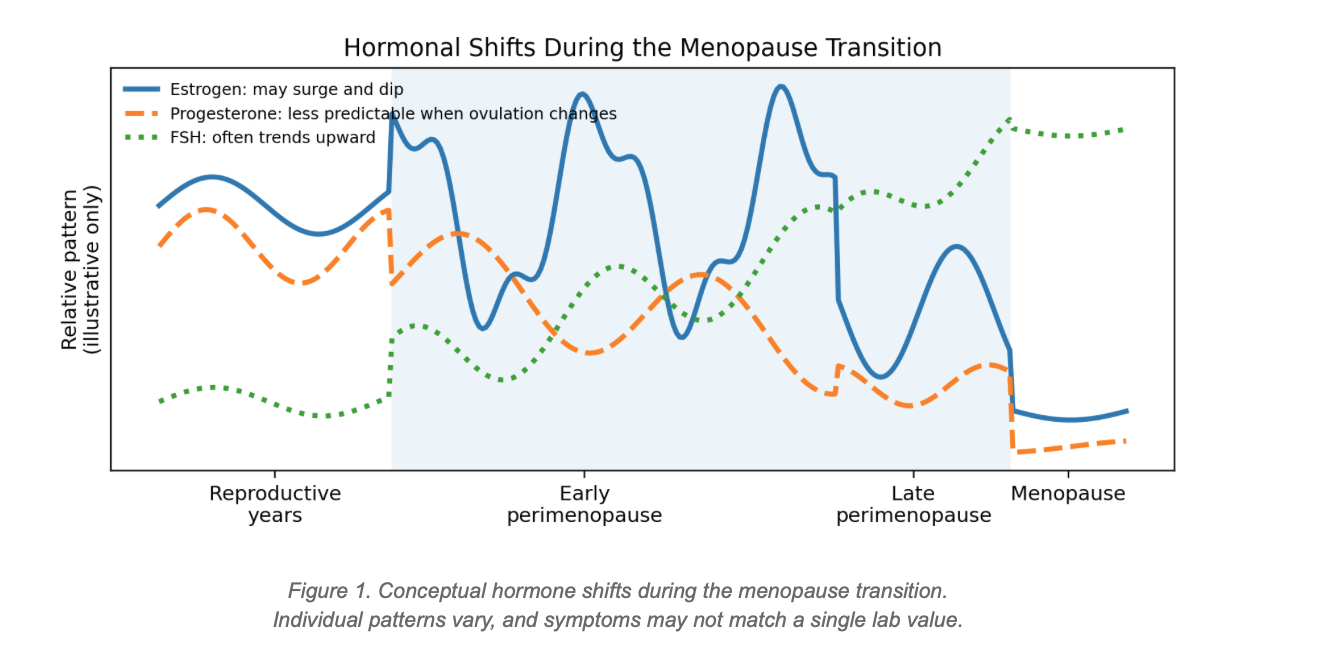
Estrogen does not simply decline in a straight line. In perimenopause, estrogen may rise high, fall low, and vary from cycle to cycle. Higher-estrogen moments may be associated with breast tenderness, headaches, irritability, or heavier bleeding. Lower-estrogen moments may show up as hot flashes, night sweats, sleep disruption, vaginal dryness, urinary symptoms, joint discomfort, or brain fog.
Progesterone is closely tied to ovulation. If ovulation becomes inconsistent, progesterone may also become inconsistent. That matters because progesterone helps balance the uterine lining and can influence sleep, mood, and bleeding patterns. Some women notice shorter cycles, more PMS-like symptoms, spotting, heavier periods, or cycles that become less predictable.
Follicle-stimulating hormone, or FSH, is the hormone from the brain that asks the ovaries to respond. As ovarian response becomes less consistent, FSH often rises and falls more dramatically. This is one reason a single hormone lab may not explain the full story.
Testosterone and DHEA also change gradually over time and may contribute to shifts in energy, libido, muscle, motivation, and sexual response. Stress hormones matter too. Cortisol does not cause perimenopause, but chronic stress, poor sleep, alcohol, under-fueling, and overtraining can make symptoms feel louder.
Conceptual diagram: hormonal shifts across the transition
This diagram is a simplified teaching tool, not a lab-value graph. Hormone patterns vary widely from person to person.
Why tracking matters
Cycle tracking is one of the most helpful tools during this phase. Tracking bleeding, cycle length, flow, sleep, mood, hot flashes, headaches, libido, vaginal symptoms, and lifestyle triggers can help you see patterns. It also gives your clinician better information than a single hormone lab, because hormone levels can change quickly during the menopause transition.
That does not mean labs are never useful. Labs can help look for anemia, thyroid disease, pregnancy, insulin resistance, PCOS/PMOS, low iron, vitamin deficiencies, or other conditions that can overlap with perimenopause. But perimenopause is often diagnosed through age, symptoms, menstrual changes, health history, and ruling out other causes when appropriate.
When should you be evaluated?
It is worth being evaluated if periods become very heavy, last longer than seven days, occur very close together, stop for months and then return, or if bleeding happens after sex. Bleeding after 12 months without a period should always be evaluated. New pelvic pain, severe mood symptoms, painful sex, recurrent vaginal or urinary symptoms, or symptoms affecting quality of life are also good reasons to schedule care.
What can help?
The good news: perimenopause is not something you just have to survive. Options may include lifestyle support, sleep strategies, nutrition, strength training, stress reduction, contraception, treatment for heavy bleeding, progesterone-based options, localized vaginal estrogen, systemic hormone therapy, nonhormonal medications, sexual health support, and evaluation for conditions such as fibroids, adenomyosis, endometriosis, thyroid disease, or PCOS/PMOS.
At Arcadia Women’s Wellness, we want women to understand that perimenopause is real, variable, and treatable. If you feel like your body, mood, sleep, period, or libido changed and no one has connected the dots, you are not alone. The goal is not to chase perfect hormones. The goal is to understand your patterns, evaluate what needs attention, and create a personalized plan that helps you feel like yourself again.
You can schedule an appointment with Arcadia Women’s Wellness here.
Medical disclaimer: This article is for education only and does not replace individualized medical advice.
Sources:
The Menopause Society – Perimenopause patient education: https://menopause.org/patient-education/menopause-topics/perimenopause
National Institute on Aging – What Is Menopause?: https://www.nia.nih.gov/health/menopause/what-menopause
Office on Women’s Health – Menopause basics: https://womenshealth.gov/menopause/menopause-basics
ReproductiveFacts.org / ASRM – Menopausal transition patient fact sheet: https://www.reproductivefacts.org/news-and-publications/fact-sheets-and-infographics/menopausal-transition-perimenopause-what-is-it/
SWAN review – The menopause transition and women’s health at midlife: https://pmc.ncbi.nlm.nih.gov/articles/PMC6784846/