
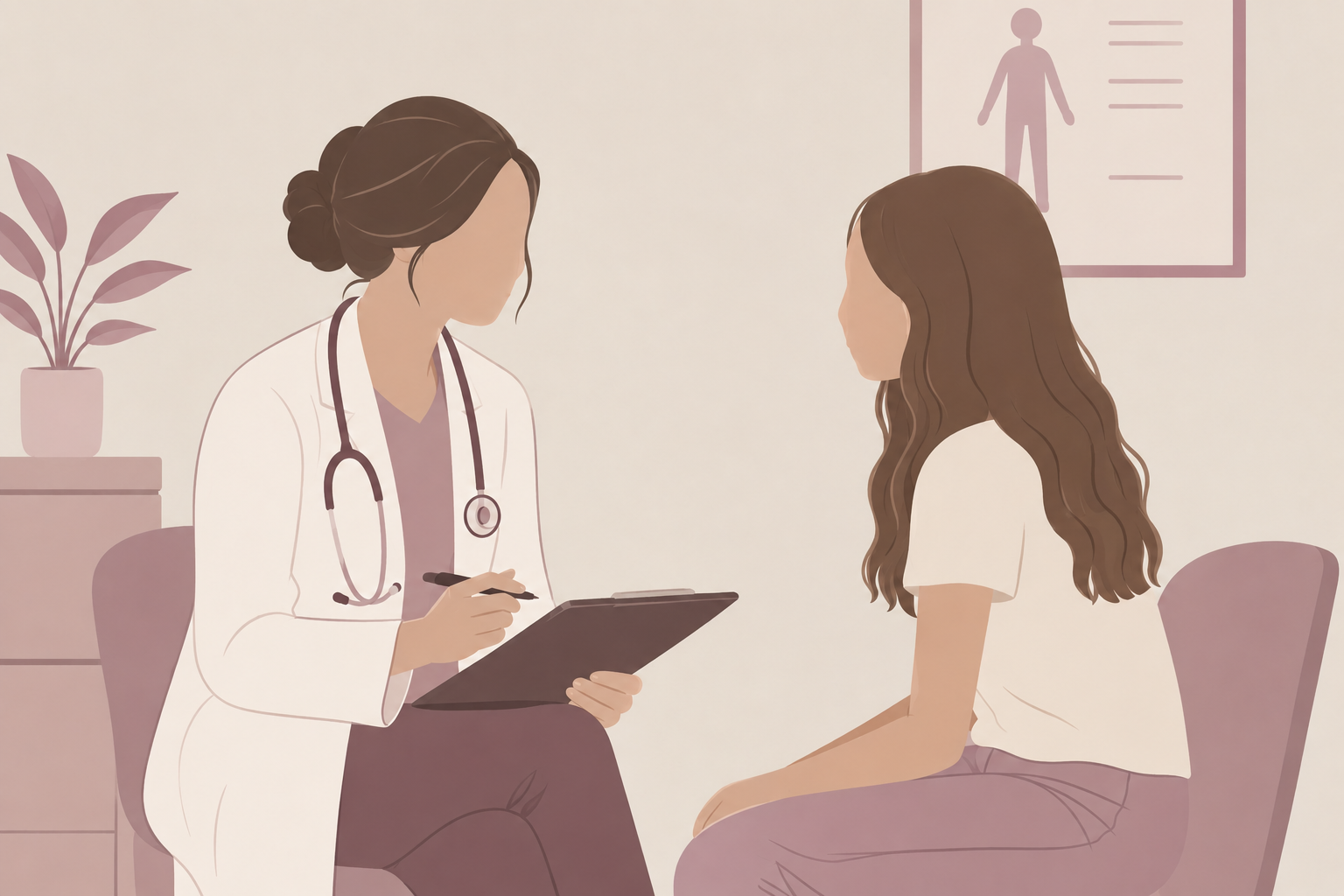
A premenarche gynecology visit is not meant to make puberty scary or overly medical. It is often an education-focused appointment designed to help a young patient understand her body before the first period begins. At Arcadia Women’s Wellness, we want this type of visit to feel calm, age-appropriate, respectful, and empowering.
Premenarche means the time before a first menstrual period. For many young patients and their families, this stage can bring a mix of curiosity, excitement, nervousness, and a lot of questions. What will the first period feel like? What supplies should be kept at school? What is normal discharge? What if cramps happen? And when should something be checked by a clinician?
“When a young person understands what is happening in her body, she is less likely to feel afraid or ashamed when changes occur. Education before the first period gives her language, confidence, and ownership of her health.” - Julia Cyr, DNP
Why schedule a visit before the first period?
Not every patient needs a separate visit before her first period, but many families find it helpful. This appointment can create a safe space to ask questions about puberty, anatomy, menstrual products, hygiene, body changes, mood, cramps, discharge, exercise, sports, and what to expect when bleeding starts. It can also help establish a relationship with a women’s health provider before there is a problem.
ACOG recommends an initial reproductive health visit during the early teen years, typically between ages 13 and 15. For some patients, a visit before the first period may be appropriate earlier, especially if puberty has started, questions are coming up, or there are symptoms that need attention.
What happens during a premenarche GYN visit?
Most premenarche visits are mostly conversation. The goal is to educate, answer questions, and make sure development is progressing in a healthy way. The visit may include:
A review of health history, medications, allergies, surgeries, and family history.
Questions about puberty changes, including breast development, body hair, growth, acne, mood changes, discharge, and cramps.
A discussion about what periods are, why they happen, and what the first period may look like.
Education about pads, tampons, period underwear, menstrual cups, changing products regularly, school preparation, and hygiene.
Guidance on what symptoms are normal and what symptoms should be evaluated.
A chance for the young patient to ask private or sensitive questions in a supportive setting.
Depending on the concern, the visit may also include basic vital signs, a general exam, or an external exam. The exam is always guided by the patient’s age, symptoms, medical need, and comfort level.
Will there be a pelvic exam?
In most cases, no. A routine pelvic exam is usually not needed before the first period. A Pap test is also not part of a premenarche visit; cervical cancer screening generally starts later, based on age and guideline recommendations. If an exam is ever recommended because of pain, bleeding, discharge, injury, a skin concern, or another symptom, the provider should explain what is being recommended and why, and the patient should be involved in the process as much as possible.
A premenarche visit should not feel like something is being “done to” the patient. It should feel like a conversation where the patient learns that her body is not embarrassing, her questions are welcome, and her comfort matters.
What should young patients know before the first period?
A first period may be light or heavier, red or brown, and may last only a few days. Early cycles can be irregular while the body is learning how to ovulate consistently. Some clear or white vaginal discharge can also occur in the months before the first period and is often a normal part of puberty. Mild cramps can happen, but severe pain that keeps a patient home from school, causes vomiting, or does not improve with usual comfort measures should not be brushed off.
It is helpful to keep a small period kit in a backpack, sports bag, or locker. This can include pads or period underwear, a clean pair of underwear, a small plastic bag for soiled clothing, wipes if desired, and a note with who to call if the first period happens at school or away from home.
When should someone be evaluated before or around the first period?
A visit is recommended if there is breast development or pubic hair very early, no puberty changes by about age 13, no period by age 15, or no period within about three years after breast development begins. Evaluation is also important for severe pelvic pain, persistent itching or burning, unusual discharge or odor, bleeding before puberty, genital skin changes, concerns about anatomy, symptoms after injury, or any situation where the patient or caregiver feels something is not right.
After periods begin, patients should also be evaluated for bleeding that soaks through products very quickly, periods lasting more than seven days, dizziness or symptoms of anemia, severe cramps, cycles that are extremely frequent or very far apart after the first several years, or symptoms such as acne and increased hair growth that may suggest a hormone pattern worth reviewing.
A note for parents and caregivers
Parents and caregivers play a powerful role in shaping how young patients feel about their bodies. Clear, calm language helps remove shame. Using correct anatomy words, answering questions honestly, keeping period supplies available, and normalizing care can make the transition into menstruation feel much less overwhelming.
It is also normal for a provider to spend part of the visit speaking directly with the young patient. This helps build trust and teaches her how to advocate for herself in healthcare settings. The goal is not to exclude parents; it is to help the patient begin building confidence in her own voice.
The bottom line
A premenarche GYN visit is an opportunity to prepare, educate, and empower. It is usually conversation-based, often does not require a pelvic exam, and can help young patients understand puberty and periods before they happen. At Arcadia Women’s Wellness, we believe body literacy starts early. When young patients understand what is normal, what is not, and how to ask for help, they are better prepared to care for themselves with confidence. You can schedule an appointment with Arcadia Women’s Wellness here.
Medical disclaimer: This article is for education only and does not replace individualized medical advice.
Sources:
ACOG Committee Opinion No. 811. The Initial Reproductive Health Visit. Obstet Gynecol. 2020. https://pubmed.ncbi.nlm.nih.gov/32976378/
ACOG Committee Opinion No. 651. Menstruation in Girls and Adolescents: Using the Menstrual Cycle as a Vital Sign. Obstet Gynecol. 2015. https://pubmed.ncbi.nlm.nih.gov/26595586/
HealthyChildren.org / American Academy of Pediatrics. Concerns Girls Have About Puberty. https://www.healthychildren.org/English/ages-stages/gradeschool/puberty/Pages/Concerns-Girls-Have-About-Puberty.aspx
KidsHealth. When Should My Daughter First Go to the Gynecologist? https://kidshealth.org/ChildrensAlabama/en/parents/first-gyn-exam.html
Phoenix Children’s. Preparing for a Gynecology Visit. https://phoenixchildrens.org/specialties-conditions/pediatric-and-adolescent-gynecology/preparing-gynecology-visit
NHS. Starting your periods. https://www.nhs.uk/conditions/periods/starting-periods/
CDC. Cervical Cancer Screening. https://www.cdc.gov/cervical-cancer/screening/index.html
CDC. HPV Vaccine Recommendations. https://www.cdc.gov/hpv/hcp/vaccination-considerations/index.html