
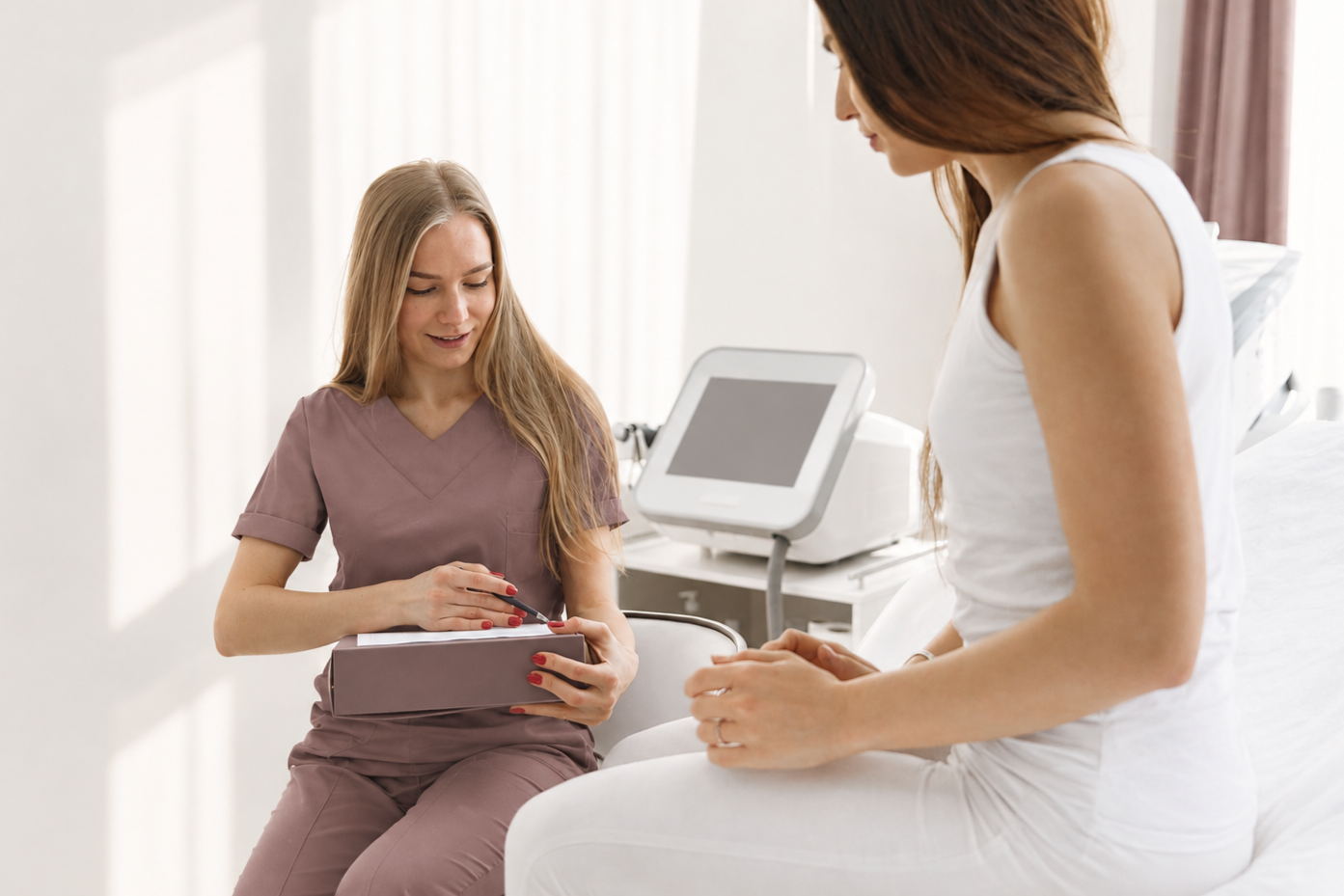
Heavy periods are not just an inconvenience. They can affect work, sleep, exercise, intimacy, travel, clothing choices, energy, iron levels, and quality of life.
Heavy periods can take over your life
If you are planning your day around bathrooms, doubling up on period products, bleeding through clothing, or avoiding activities because of your cycle, it may be time to discuss treatment options.
One option for selected patients is endometrial ablation. At Arcadia Women’s Wellness, we believe the best treatment starts with understanding the cause of bleeding, reviewing imaging carefully, and discussing options in a way that helps you feel informed and supported.
What is endometrial ablation?
Endometrial ablation is a procedure that treats heavy menstrual bleeding by destroying or removing the endometrial lining, which is the tissue that builds up and sheds during a period. The goal is to reduce bleeding. Some patients have much lighter periods afterward, and some stop bleeding completely.
Ablation is not the same as a hysterectomy. The uterus stays in place, and there are no abdominal incisions with most modern ablation techniques. It is also not birth control. Pregnancy after ablation can be dangerous, so reliable contraception is still needed until menopause.
What is Cerene endometrial cryotherapy?
Cerene is an endometrial ablation device that uses cryotherapy, or controlled cold energy, to treat the uterine lining. Instead of using heat, radiofrequency energy, heated fluid, or microwave energy, Cerene uses cooling technology to freeze the endometrium and reduce future bleeding.
The FDA approved the Cerene Cryotherapy Device for endometrial cryoablation in premenopausal women with heavy menstrual bleeding due to benign causes when childbearing is complete. In patient-facing terms, this means Cerene may be an option for someone who has heavy periods, does not desire future pregnancy, and has completed the appropriate evaluation to rule out concerning causes of bleeding.
What makes Cerene different?
The first major difference is the use of cold rather than heat. Many ablation technologies work by heating the lining of the uterus. Cerene uses cryotherapy, which may be more comfortable for some patients and can often be performed without general anesthesia.
The second difference is convenience. Cerene is designed as an in-office treatment, and the active treatment time is about 2.5 minutes. That does not mean the entire appointment is only 2.5 minutes, because preparation, counseling, pain management, recovery, and safety checks still matter. But the actual cryotherapy portion is short.
The third difference is the data on tolerability and uterine cavity access after treatment. In clinical studies, Cerene reduced heavy bleeding with high patient satisfaction, and investigators were able to access and evaluate the uterine cavity in most patients one year after treatment. This matters because some ablation methods can make future evaluation of the uterine cavity more difficult due to scarring or adhesions.
Who may be a good candidate?
Cerene may be considered for premenopausal patients with heavy menstrual bleeding from benign causes who have completed childbearing. It is not for patients who are pregnant, want future pregnancy, have or may have uterine cancer, have an active genital, urinary, or pelvic infection, or have an IUD in place at the time of treatment.
It is also not the right choice for every cause of bleeding. For example, certain fibroids, polyps, adenomyosis, bleeding disorders, thyroid issues, medication effects, or endometrial changes may require a different treatment plan. That is why the evaluation before ablation is so important.
What evaluation is needed before ablation?
Before any ablation, your provider needs to understand why bleeding is happening and whether the uterus is appropriate for the procedure. Workup may include a detailed bleeding history, pregnancy testing when appropriate, bloodwork to check for anemia or other contributors, pelvic exam, advanced gynecologic ultrasound, endometrial biopsy, saline infusion sonogram, or hysteroscopy in selected patients.
At Arcadia Women’s Wellness, advanced gynecologic ultrasound is especially important because the size and shape of the uterus, the location of fibroids or polyps, and the appearance of the uterine lining can change the conversation about treatment. Ablation should be matched to the patient, not chosen from a one-size-fits-all menu.
What can you expect during and after treatment?
If Cerene is appropriate, the procedure is typically done through the cervix, without abdominal incisions. Your provider will review pain-control options ahead of time. Depending on your medical history and comfort level, this may include oral medications, a cervical block, anti-anxiety support, or other individualized strategies.
After ablation, patients may have cramping, light bleeding, watery discharge, or temporary fatigue. Recovery instructions vary, and your provider will review when to return to exercise, sex, tampons, baths, swimming, and regular activity. Some patients notice improvement within the first few cycles, but final bleeding patterns may take time to settle.
The goal is better bleeding, not a guarantee of no period
One of the most important things to understand is that ablation is meant to reduce heavy bleeding, not guarantee that periods disappear forever. For many patients, success means bleeding becomes lighter, shorter, more predictable, and less disruptive. Some patients become amenorrheic, meaning they no longer have periods, but that is not the only definition of success.
If bleeding continues, returns, or new pain develops after ablation, follow-up evaluation is important. Even after ablation, new or abnormal bleeding should not be ignored.
The bottom line
Cerene endometrial cryotherapy is a newer ablation option for selected patients with heavy menstrual bleeding who have completed childbearing. What makes it different is its use of cold energy, potential for in-office treatment, short active treatment time, strong tolerability data, and encouraging data on the ability to evaluate the uterine cavity after treatment.
At Arcadia Women’s Wellness, we help patients understand why they are bleeding, whether ablation is appropriate, and how Cerene compares with other options such as medication, hormonal IUDs, hysteroscopic procedures, fibroid treatment, or hysterectomy. You can schedule a visit with Arcadia Women’s Wellness here.
Want clear women’s health education? Join the Arcadia Women’s Health Library for practical guidance on heavy periods, hormones, procedures, pelvic health, and personalized wellness.
Medical disclaimer: This article is for education only and does not replace individualized medical advice.
Sources:
FDA PMA: Cerene Cryotherapy Device - https://www.accessdata.fda.gov/scripts/cdrh/cfdocs/cfpma/pma.cfm?id=P180032
Curlin et al., Journal of Minimally Invasive Gynecology, 2021 - https://pubmed.ncbi.nlm.nih.gov/32835865/
Curlin and Anderson, International Journal of Women’s Health, 2022 - https://pubmed.ncbi.nlm.nih.gov/35983177/
Curlin et al., Journal of Minimally Invasive Gynecology, 2022 - https://pubmed.ncbi.nlm.nih.gov/34839060/
Cerene Important Safety Information - https://www.cerene.com/safety-information